30 Great Myths about the Romantics by Duncan Wu
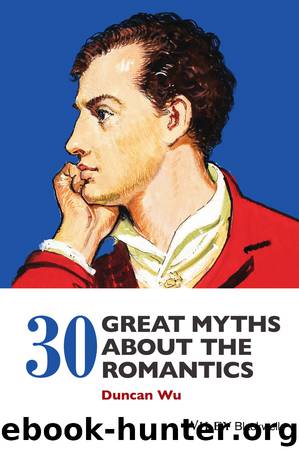
Author:Duncan Wu
Language: eng
Format: epub
ISBN: 9781118843185
Publisher: Wiley
Published: 2015-04-07T00:00:00+00:00
Notes
1 Benita Eisler, Byron: Child of Passion, Fool of Fame (London: Hamish Hamilton, 1999), p. 396.
2 Michael and Melissa Bakewell, Augusta Leigh, Byron's Half-Sister: A Biography (London: Chatto & Windus, 2000), p. 104.
3 It is Paul Douglass's contention, in The Cambridge Companion to Byron that, by the time Byron separated from his wife, he ‘probably…[had] a daughter by Augusta’; see ‘Byron's Life and his Biographers’, in The Cambridge Companion to Byron, ed. Drummond Bone (Cambridge: Cambridge University Press, 2004), p. 13.
4 Lord Byron, journal entry for 14 November 1813, in Byron's Letters and Journals, ed. Leslie A. Marchand (13 vols., London: John Murray, 1973–94), iii. 205.
5 Lord Byron to Augusta Leigh, 17 May 1819, ibid., vi. 129.
6 Lord Byron to Augusta Leigh, 5 October 1821, ibid., viii. 234.
7 Lord Byron to Lady Melbourne, 25 April 1814, ibid., iv. 104.
8 Fiona MacCarthy, Byron: Life and Legend (London: John Murray, 2002), p. 214. MacCarthy is not the only biographer to have questioned Byron's paternity of Medora; see also Doris Langley Moore, The Late Lord Byron (Philadelphia and New York: Lippincott, 1961), pp. 301–2.
9 MacCarthy, Byron: Life and Legend, p. 215.
10 Lady Melbourne to Lord Byron, 25 April 1814, in Byron's ‘Corbeau Blanc’: The Life and Letters of Lady Melbourne, ed. Jonathan David Gross (Liverpool: Liverpool University Press, 1997), p. 171.
11 Ibid., p. 172.
12 Peter Cochran writes an entire chapter on this theme in Byron's Romantic Politics: The Problem of Metahistory (Newcastle upon Tyne: Cambridge Scholars, 2011), pp. 191–207.
13 John Cam Hobhouse, Contemporary Account of the Separation of Lord and Lady Byron (London: privately printed, 1870), p. 104.
14 Ibid.
15 Roderick Beaton, Byron's War: Romantic Rebellion, Greek Revolution (Cambridge: Cambridge University Press, 2013), p. 21.
16 The Diary of Thomas Moore, ed. Wilfred Dowden, Barbara Bartholomew, and Joy L. Linsley (6 vols., Newark and London: Associated University Presses, 1983–91), iii. 1079.
17 The Works of Lord Byron (14 vols., London: John Murray, 1832), vi. 242.
18 G. Wilson Knight, Lord Byron's Marriage: The Evidence of the Asterisks (London: Kegan Paul, 1957), p. 41. On this subject see also, inter alia, James Soderholm, Fantasy, Forgery, and the Byron Legend (Lexington: University Press of Kentucky, 1996), p. 153.
19 Alan Rawes, ‘“That Perverse Passion” and Benita Eisler's “Byronic” Biography of Byron’, in Romantic Biography, ed. Arthur Bradley and Alan Rawes (Aldershot, Hants.: Ashgate, 2003), pp. 74–92, 76. I am indebted throughout this essay to Rawes's thoughtful and persuasive analysis.
20 Judy Egerton, George Stubbs, Painter. Catalogue Raisonné (New Haven: Yale University Press, 2007), p. 319.
21 Lord Byron to Augusta Leigh, 20 October 1822, in Byron's Letters and Journals ed. Marchand, x. 15.
22 Harriet Beecher Stowe, Lady Byron Vindicated: A History of the Byron Controversy (London: Sampson Low, 1870), p. 233. In fact, Stowe first alleged incest in September 1869: see Paul Baender, ‘Mark Twain and the Byron Scandal’, American Literature 30 (1959), 467–85, and Susan McPherson, ‘Opening the Open Secret: The Stowe-Byron Controversy’, Victorian Review 27 (2001), 86–101.
23 Lady Byron to Lady Noel, 24 January 1816, as quoted by S. M.
Download
This site does not store any files on its server. We only index and link to content provided by other sites. Please contact the content providers to delete copyright contents if any and email us, we'll remove relevant links or contents immediately.
4 3 2 1: A Novel by Paul Auster(12405)
The handmaid's tale by Margaret Atwood(7773)
Giovanni's Room by James Baldwin(7354)
Big Magic: Creative Living Beyond Fear by Elizabeth Gilbert(5780)
Asking the Right Questions: A Guide to Critical Thinking by M. Neil Browne & Stuart M. Keeley(5779)
Ego Is the Enemy by Ryan Holiday(5456)
The Body: A Guide for Occupants by Bill Bryson(5104)
On Writing A Memoir of the Craft by Stephen King(4948)
Ken Follett - World without end by Ken Follett(4740)
Adulting by Kelly Williams Brown(4582)
Bluets by Maggie Nelson(4566)
Eat That Frog! by Brian Tracy(4547)
Guilty Pleasures by Laurell K Hamilton(4455)
The Poetry of Pablo Neruda by Pablo Neruda(4113)
Alive: The Story of the Andes Survivors by Piers Paul Read(4037)
White Noise - A Novel by Don DeLillo(4019)
Fingerprints of the Gods by Graham Hancock(4009)
The Book of Joy by Dalai Lama(3996)
The Bookshop by Penelope Fitzgerald(3857)
